The End of the Eyeball: How AI is Killing Ads (And What's Coming Next)
I spent the last week down a rabbit hole. AI chatbots vs Google. Agentic shopping agents. Amazon suing startups. Payment rails for bots. And a $1 trillion market that nobody's quite figured out yet. Here's what I found: the advertising industry isn't evolving. It's being replaced.
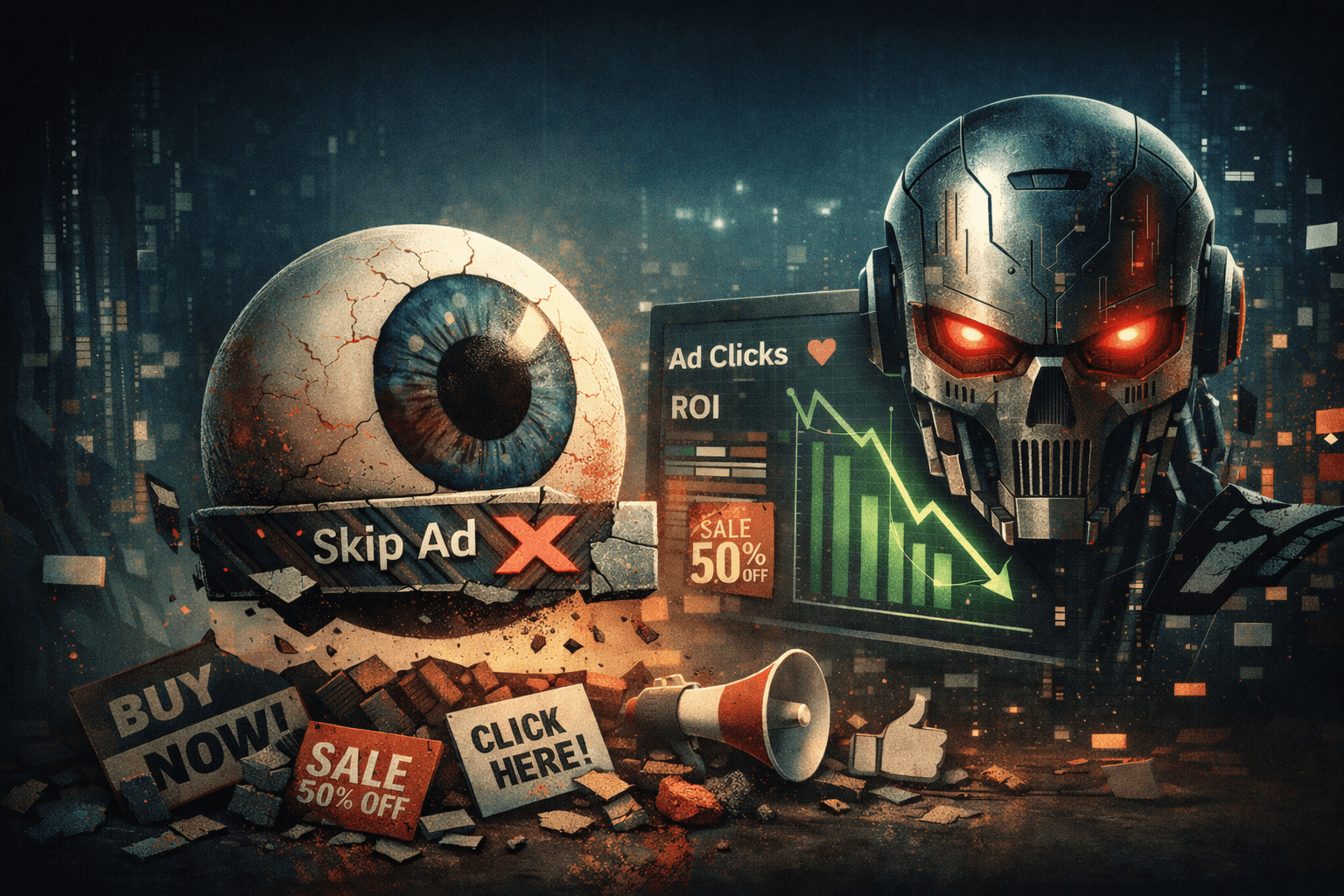
The 30-Year Model is Breaking
Advertising has worked the same way since banner ads in 1994: capture attention, influence decisions, measure clicks. Impressions. CTR. Conversions. The whole game is built on one assumption — a human is browsing, scrolling, considering.
That assumption is dying.
Google's AI Overviews now reach 1.5 billion users. ChatGPT crossed 800 million weekly users. And here's the brutal stat: AI answer boxes cut click-through rates by 70%. Not a typo. Seventy percent.
When someone asks "best wireless earbuds under $100," they used to get a page of links. Now they get an answer. No scrolling. No sponsored results fighting for position. No second-page SEO plays. Just a synthesized response and maybe a link or two.
The ad never gets seen.
The Amazon-Perplexity War is the Canary
Amazon sued Perplexity in November 2025. Not over some abstract IP claim — over Perplexity's Comet browser letting AI agents complete purchases on Amazon.com.
Think about what that means. A user tells Comet: "Buy me running shoes, size 11, under $150, good arch support." The agent searches Amazon, finds options, compares reviews, and checks out. No browsing. No sponsored product impressions. No "customers also bought" upsells.
Amazon has blocked 47 AI bots from crawling its site. All the major players — OpenAI, Google, Anthropic, Meta. They're building a wall around their $56 billion ad business because they see what's coming.
Here's the thing: Amazon makes more money from ads than from direct sales. Brands pay to appear in search results. If agents bypass search entirely, that revenue evaporates.
Perplexity's CEO called the lawsuit "a bully tactic." His argument? "Amazon should love this. Easier shopping means more transactions."
He's missing the point. Amazon doesn't want transactions. Amazon wants influence. They want to show you six sponsored results before you find what you need. They want to upsell you batteries and a warranty. They want your browsing data to feed the recommendation engine.
Agents don't browse. Agents don't get influenced. Agents just optimize.
The Fundamental Problem: Agents Don't Have Eyeballs
This is where it gets weird. The entire advertising industry is built on human psychology. Attention. Emotion. Impulse. Brand recall. Social proof.
None of that works on an AI agent.
When a human shops, they're susceptible to a beautiful product photo, a limited-time discount banner, a "bestseller" badge that might be half BS. When an agent shops, it parses structured data, weighs review scores, compares specs, and picks the optimal choice.
So here's the question every brand needs to answer: how do you advertise to a machine?
The early data suggests agents care about a few things:
Review counts and average ratings — Columbia and Yale research found these heavily influence agent recommendations
Structured product data — clean metadata, accurate specs, parseable descriptions
Inventory and pricing accuracy — agents check in real-time and will skip you if your data's stale
Authority signals — citations in training data, backlinks, brand mentions
Notice what's missing? Creative. Emotional appeal. Brand storytelling. The stuff agencies have built empires on.
Three Futures for Advertising
I've been thinking about this as three possible scenarios:
Scenario 1: Retailers keep control. Amazon, Walmart, and Shopify syndicate their product feeds and ad inventory into AI assistants. The agent becomes infrastructure — powerful but dumb. Brands still bid for placement through the retailer's DSP. The retailer keeps the brand relationship.
Scenario 2: AI platforms build their own ad layer. OpenAI, Perplexity, and Google decide the discovery moment inside agent responses is too valuable to give away. They build their own ad networks. Brands bid directly for "agent recommendations." Retailers become fulfillment.
Scenario 3: Hybrid chaos. Some mix of both, with different protocols for different platforms, and brands playing arbitrage between them.
We're probably headed for #3. Which means the next few years will be a mess of competing standards, walled gardens, and power grabs.
The New Metrics
Impressions and CTR are going to look quaint. Here's what's replacing them:
Share of AI recommendations — How often does the agent surface your product when someone asks a relevant question? This is the new "page one ranking."
Citation frequency — Are you in the training data? Are you being retrieved in real-time searches? If the agent doesn't know you exist, you don't exist.
Agent conversion rate — When recommended, do users approve the purchase? This is weirdly close to the old funnel, but compressed into a single moment.
Influence over agent behavior — Can you shape how agents evaluate products in your category? This is the dark art no one's figured out yet.
The companies winning this game aren't running better ad campaigns. They're optimizing their data for machine parsing.
The Monetization Shift
Follow the money. It's moving in three directions:
Transaction fees. When you buy through ChatGPT, OpenAI takes a cut. Perplexity partnered with PayPal. Visa and Mastercard are racing to build agent payment rails. The tollbooth model is coming.
Sponsored recommendations. Perplexity already has "sponsored questions" — brands pay to be surfaced for relevant queries. The key: the AI still generates the answer. The brand just pays for presence.
Revenue share with sources. Perplexity's publisher program pays content creators when their work is cited. 80% of revenue goes to partners. This is the new SEO — except you're optimizing to be cited, not clicked.
The scary projection: Kearney estimates average selling prices will drop 8%, fulfillment costs will rise 10-15%, and agent platforms will take ~4% per transaction. Agents are ruthless optimizers. No impulse buys. No brand loyalty unless it's programmed in.
So What Do You Actually Do?
If you're a brand or a marketer, the playbook is getting rewritten. A few things that seem clear:
Optimize for parsing, not persuasion. Your product data — specs, pricing, availability, reviews — needs to be structured, accurate, and machine-readable. The agent isn't going to be charmed by your brand voice. It's going to parse your schema.
Reviews become even more critical. Agents weight review counts and ratings heavily. The difference: they're not swayed by emotional testimonials. They're aggregating signals. Volume and consistency matter more than one glowing case study.
Get into the training data. If the agent doesn't know you exist, you're not in the consideration set. That means being cited, being linked to, being present in the corpus that models are trained on or retrieve from. This is SEO's weird cousin — call it AIO (Agent Information Optimization).
Watch the protocol wars. OpenAI has Agentic Commerce Protocol with Stripe. Google's building agent checkout into Gemini. Perplexity partnered with PayPal. Whoever controls the transaction layer captures the margin. Brands might need to pick sides — or integrate with all of them.
The uncomfortable part: a lot of what made advertising work — creativity, emotional resonance, brand building — might matter less when the buyer is a machine. Not zero. But less.
The Uncomfortable Truth
Advertising as we know it — the creative, the campaigns, the media buys, the brand storytelling — might be entering a long decline. Not dying tomorrow. But structurally weakening as agents eat more of the discovery layer.
The winners in this world:
Agent platforms — they control the funnel
Products with objectively superior data — agents are rational
Infrastructure providers — payments, identity, logistics
Brands that figure out "agent SEO" — whatever that turns out to mean
The losers:
Retail media networks — ad budgets will migrate upstream
Brands dependent on emotional buying — agents don't impulse purchase
Anyone who's just a pass-through — if you're not adding value the agent can measure, you're getting cut
The question I keep asking: what would JARVIS recommend? Because increasingly, that's the buyer.
If you're thinking about this space — whether you're in commerce, advertising, or building the agent layer itself — I'd love to hear what you're seeing. The playbook is being written in real-time, and nobody has it figured out yet.
Hit me up on LinkedIn.
